The only funnel builder for top-notch products in ANY niche come to check those bonuses, unique and no one has them
Monday, October 19, 2020

Friday, October 16, 2020
ProfitMeet Review | My Review of profitmeet | Real Custom Bonuses
The Zoom killer? the best alternative for those expensive software, check out my custom made bonuses for ProfitMeet
Wednesday, October 14, 2020
SyndBuddy 2.0 Review | My Review of syndbuddy 2.0
syndbuddy 2.0 review the #1 social exchange-getting software that allows you to get real social shares and syndication to your sites and videos
Thursday, October 8, 2020
Wednesday, September 30, 2020
Continuum Review | My Review of continuum
The best / cheapest way to make high ticket commissions a no brainer I might add #howToGetContinuum #marketing #BestAutomatedWebinarPlatform #socialmedia #smallbusiness #sales #digitalmarketing #seo #branding #marketingstrategy #contentmarketing
Tuesday, January 15, 2019
Tuesday, December 11, 2018
QlistZ Review
This course QlistZ esay to follow step-by-step training showing you how anyone can build a targeted email list for FREE and monetize it to get passive income on autopilot.
This method is bang up to date and working right now in 2018. It works in any niche, you don't need any tech skills, and you can withdraw it up as more as you suchlike to maximize your earnings.
This method is bang up to date and working right now in 2018. It works in any niche, you don't need any tech skills, and you can withdraw it up as more as you suchlike to maximize your earnings.
Not exclusive that but there's also a glutted showcase take with grounds display just how Andy generated $458.75 in low a week doing this
https://youtu.be/EY7PasLkCN4
These life, there are so some varied Net marketing courses merchandising methods which either don't use, or expenditure a lot to put into point.
But QlistZ is a proven method which will change you results in lower than 24 hours, and the best thing is that you don't have to spend any money on traffic.
Not only will you learn how to build an email list super-fast in any niche, but more importantly you'll also learn the best way to make money from that list.
Follow These 3 Elementary Steps To Transform Your Online Business Today...
Step #1: Follow the step-by-step blueprint and start getting FREE traffic to your opt-in pages in under 24 hours
Step #2: Shape a targeted list of netmail subscribers to support your offers to in ANY status.
Step #3: Monetize your traffic and subscribers instantly and start making regular profits on autopilot.
https://youtu.be/EY7PasLkCN4
Saturday, November 24, 2018
0 to 100 in 24 hrs
Get +Bonuses Here: https://bonuscrate.com/g/4858/38529/
in there will get access on how to claim your bonuses that have been given exclusively to me
Watch over his shoulder as SUPER Affiliate Jono Armstrong has everything taken away from him and is forced to earn $100 in 24 Hours in a bid to get it all back.
All he has is an internet connection and his knowledge of Internet Marketing, no paid tools or traffic, no JV partners, no list.
If you’re a newbie or if you’ve been struggling to make consistent income online this A-Z video course is perfect for you.
It follows THE step-by-step blueprint that in 0 to $100 in 24 hrs all top marketers follow. price update get it now for less than $12
https://youtu.be/1FZWKmQqvHQ
This step-by-step video training takes you by the hand and shows you EXACTLY how “From Zero To $100 In 24 hours” works and how you can start using this to make money TODAY. (hey work you a$$ off as well ok don't you just sit on it and do nothing)
The best part about “From Zero To $100 In 24 hours” is that don’t need a list, a product, prior experience or ANYTHING ELSE to make money, and we’ll show you the simple steps to get big results extremely quickly inside.
Plus, this is truly a method ANYONE can use to get FAST result even if you never made a dollar online. That’s why we challenged Jono in the first place; to prove that ANYONE can do this and FAST.
in there will get access on how to claim your bonuses that have been given exclusively to me
Watch over his shoulder as SUPER Affiliate Jono Armstrong has everything taken away from him and is forced to earn $100 in 24 Hours in a bid to get it all back.
All he has is an internet connection and his knowledge of Internet Marketing, no paid tools or traffic, no JV partners, no list.
If you’re a newbie or if you’ve been struggling to make consistent income online this A-Z video course is perfect for you.
It follows THE step-by-step blueprint that in 0 to $100 in 24 hrs all top marketers follow. price update get it now for less than $12
https://youtu.be/1FZWKmQqvHQ
This step-by-step video training takes you by the hand and shows you EXACTLY how “From Zero To $100 In 24 hours” works and how you can start using this to make money TODAY. (hey work you a$$ off as well ok don't you just sit on it and do nothing)
The best part about “From Zero To $100 In 24 hours” is that don’t need a list, a product, prior experience or ANYTHING ELSE to make money, and we’ll show you the simple steps to get big results extremely quickly inside.
Plus, this is truly a method ANYONE can use to get FAST result even if you never made a dollar online. That’s why we challenged Jono in the first place; to prove that ANYONE can do this and FAST.
Tuesday, July 24, 2018
PROFITEER review
Grab Profiteer here https://bonuscrate.com/g/4858/32158/
Remember In the Gold Rush? The most successful people weren’t digging for gold,
they were selling SHOVELS to the gold diggers!
These PROFITEERS made HUGE money charging high prices for something
others desperately needed.
Enter Fast Profit Engines ...
Profiteer is a 17 module course presented by affiliate softeware creator Mos Mari
and super affiliate marketer Jason Fulton, in a nutshell is basicaly how a beginner
would get started with domain flipping and includes an AWESOME word Press
plug in, from start to finnish this trainig course is how to create a daily income
by flipping websites and put them to aution
Inside Profiteer we are going to show your customers how to make these
Fast Profit Engines that people desperately need and flip them quickly for
high profits, we are also bundling up a software to automate the whole process.
https://youtu.be/mZiO3b8OYKU
Remember In the Gold Rush? The most successful people weren’t digging for gold,
they were selling SHOVELS to the gold diggers!
These PROFITEERS made HUGE money charging high prices for something
others desperately needed.
Enter Fast Profit Engines ...
Profiteer is a 17 module course presented by affiliate softeware creator Mos Mari
and super affiliate marketer Jason Fulton, in a nutshell is basicaly how a beginner
would get started with domain flipping and includes an AWESOME word Press
plug in, from start to finnish this trainig course is how to create a daily income
by flipping websites and put them to aution
Inside Profiteer we are going to show your customers how to make these
Fast Profit Engines that people desperately need and flip them quickly for
high profits, we are also bundling up a software to automate the whole process.
https://youtu.be/mZiO3b8OYKU
Monster PLR Firesale
You can get Monster PLR Firesale here https://bonuscrate.com/g/4858/32104/
If you are an internet marketer then you need to heard that there-s a launch on
July 20th 2018 a new product called Monster PLR Firesale done by internet marketers Paul Counts and Shreya Banerjee.
Monster PLR Firesale is an excelent product packed with 6+ products created by IM Experts yes indeed Experts
with Private Label Rights that will help you earn money selling these in products. This is a Top-Selling JVZoo product
in the lucrative Affiliate Blogging Niche Market & Position Yourself for monster success.
Monster PLR Firesale is the fast tracks your path to success as a digital entrepreneur!
https://www.youtube.com/watch?v=F0_bITMjIJs
If you are an internet marketer then you need to heard that there-s a launch on
July 20th 2018 a new product called Monster PLR Firesale done by internet marketers Paul Counts and Shreya Banerjee.
Monster PLR Firesale is an excelent product packed with 6+ products created by IM Experts yes indeed Experts
with Private Label Rights that will help you earn money selling these in products. This is a Top-Selling JVZoo product
in the lucrative Affiliate Blogging Niche Market & Position Yourself for monster success.
Monster PLR Firesale is the fast tracks your path to success as a digital entrepreneur!
https://www.youtube.com/watch?v=F0_bITMjIJs
Saturday, July 14, 2018
El Bandito Review
El Bandito
This product will teach you a really cool way of how you
can pretty much double your results with very little extra effort.
I'll be implementing this myself, and i'm very excited to do so
This an amazing little twist on affiliate marketing that has taken
marketers from getting %50 commissions or less to crank it up
to %100
How ...by getting ressell rights to an already well perform product
that's already been launch
On here I will explain what this method is all about
You are going to promote affiliate products with a proven
and successful results and also you will get the re-seller rights
for each of these products -like I said previously-
This is really cool for begginners since various product owners
will possibly allow you to promote AFTER initial lauch
Plus you can sort it out witch have low refind rates
and witch ones have high conv. rates
The really beautiful thing of El Bandito is "the bridge page" technique
that will skyrocket conversion rates
On their over 15 detailed tutorials a case study,
He goes over every detail from the email funnel
set-up to the creation of your bridge page
this method has a ton of good thing in it.
https://youtu.be/JR2scxfcv34
This product will teach you a really cool way of how you
can pretty much double your results with very little extra effort.
I'll be implementing this myself, and i'm very excited to do so
This an amazing little twist on affiliate marketing that has taken
marketers from getting %50 commissions or less to crank it up
to %100
How ...by getting ressell rights to an already well perform product
that's already been launch
On here I will explain what this method is all about
You are going to promote affiliate products with a proven
and successful results and also you will get the re-seller rights
for each of these products -like I said previously-
This is really cool for begginners since various product owners
will possibly allow you to promote AFTER initial lauch
Plus you can sort it out witch have low refind rates
and witch ones have high conv. rates
The really beautiful thing of El Bandito is "the bridge page" technique
that will skyrocket conversion rates
On their over 15 detailed tutorials a case study,
He goes over every detail from the email funnel
set-up to the creation of your bridge page
this method has a ton of good thing in it.
https://youtu.be/JR2scxfcv34
Tuesday, September 4, 2012
Apple, Google Patent Bloodbath May Be Indefinitely Postponed
Despite the acrimony that has grown between Apple and Google over patent infringement allegations -- mostly related to Android -- the companies apparently are open to talking through some of their differences. Or perhaps they're just setting up the appearance of good-faith negotiations in advance of a no-holds-barred legal slugfest.
The great patent showdown expected to eventually take place between Apple and Google in some courtroom, somewhere, may never happen. The two companies are in talks on a range of intellectual property issues, according to an exclusive report by Reuters that specifically cites the issues the two companies have with each other over mobile patents.
To date, the talks have consisted of a phone conversation between Google CEO Larry Page and Apple CEO Tim Cook, supplemented by lower-level executive discussions, according to Reuters.
Of course, the uber conglomerates may wind up in a courtroom despite the outreach. Certainly, neither company would be cowed by the prospect of huge legal fees if it comes to that.
Apple has just scored an unmitigated victory against Samsung and has many reasons to press forward, not the least of which is Steve Job's legacy. Jobs was never one to shy away from a patent fight, especially against Google.
An Easier Path
On the other hand, avoiding the courtroom through a negotiated truce undeniably makes sense, Peter S. Vogel, a partner with Gardere Wynne Sewell, told. Why go through a protracted legal battle that could have surprising turns if a settled offer gets you at least some of what you want?
Also, Samsung has vowed to appeal; Apple can count on years of legal wrangling with Samsung.
"Apple may be pleased about its award against Samsung, but as you point out, it's not over until all appeals are resolved or a final settlement agreement is signed," Christopher M. Collins, an attorney with Vanderpool, Frostick & Nishanian, told.
The companies have numerous areas of dispute, he noted, but there are also numerous areas where they can help each other.
A global settlement between Apple and Google is possible, Collins added.
"Due to the fact that there are so many details to be worked out, Cook and Page would have to reach agreement at the top level of abstraction first," he explained. "Then, by power of their respective personalities, they would have to ensure that the details would be worked out at the lower levels."
If that is the direction these talks take, then we will hear about it from numerous sources as the implementation is ramped up, which would probably be months away, Collins speculated. "In the meantime, you may still hear the saber-rattling from Apple and the necessary beating on the Google shields in response."
Tim Cook's Quieter Approach
If Steve Jobs were still at the helm of Apple, such speculation would be moot -- but he is not. Cook has a number of new considerations to attend to, such as proving that Apple still has the innovation gene, N. Venkat Venkatraman, a professor of management at Boston University, told .
"I think Tim Cook now has the moral upper hand to deal with Google while he is quietly distancing Apple's dependence on Google with its own Maps -- and possibly other software applications as well," he said. "I am also sure that if the talks fail, Apple and Google will be in the courts just as Apple did with Samsung after their talks failed."
Another consideration for Apple is that it must now look reasonable to the courts -- which an effort at negotiation could achieve, Rob Enderle of the Enderle Group told.
"This isn't a change in strategy ; it is consistent with a strategy tied to winning," he pointed out. "It is unlikely, unless Samsung/Google get more leverage, that Apple's goal of eliminating Android will change."
Monday, September 3, 2012
Sony’s New TV Could Put HD to Shame – If Anyone Buys It
High-definition TV has hit its stride, but already television makers like Sony want to usher in the next wave of ultra-sharp resolution. 4K a standard with four times the pixels of 1080p. Basically that means the viewer can sit closer to a larger TV without seeing individual pixels. But questions remain, including where viewers will need to go to get 4K content.

Sony on Thursday showed off an 84-inch TV set with 4K resolution technology at the IFA consumer show in Germany.
The Sony set adheres to the 4K UHDTV standard, which is 3,840 by 2,160 pixels. It offers four times the number of pixels found in the 1080p HDTV standard, which measures 1,920 x 1,080.
“With 1080p passive 3D TV, the viewer sees 540 lines of resolution instead of the full 1,080,” Michael Inouye, a senior analyst at ABI Research, told TechNewsWorld. “With 4K users will get the full 1080p 3D image. Sony’s TV will offer passive 3D.”
Spec’ing Out the Behemoth
Sony’s 84-inch TV incorporates the company’s 4K X-Reality Pro super-resolution picture quality engine optimized for 4K TV. This can render content with different resolutions, such as HD digital broadcasts or Blu-ray disc content, into 4K images, the company said.
The TV has a 60-degree viewing angle, and the resolution allows users to sit quite close to the screen and still see clear images. “At 84 inches, the 4K resolution on this set allows for viewing images even close up, without degradation or pixilation,” Sony spokesperson Rob Manfredo told TechNewsWorld.
“Some TV vendors have claimed that existing technology can help them make larger-screen TVs that only require the same viewing distance as current major TV models,” Jia Wu, a research director atStrategy Analytics, remarked.
“We were standing one-and-a-half to two feet from the screen and the images looked really great,” Sweta Dash, an analyst at IHSiSuppli who was at IFA, told TechNewsWorld. “Sony was showing Blu-ray content.”
“PlayMemories Studio 3,” a PlayStation 3 software package that lets users organize and play back photographs on the 4K TV, will be offered with the device by next year. The TV comes with 3D glasses.
Owners will be able to access services from the Sony Entertainment Network through the TV.
Whatcha Gonna Show Me?
Will there be sufficient content for the Brava 4K TV?
“Content is a limiting factor,” ABI’s Inouye said. “There have been select demonstrations of 4K, Sony offers an upscaling 4K Blu-ray player and YouTube has a few videos in 4K, but aside from this, there’s not much else.”
Most movie content can be rendered on 4K TVs because 4K is equivalent to cinema-quality content, Strategy Analytics’ Wu told TechNewsWorld. However, the format in which this content will be delivered has not yet been decided.
“There have been talks between the Blu-ray Disc Association and Sony and other vendors about compressing 4K content into Blu-ray discs,” Wu continued. “But clearly the lack of 4K content will be an issue for the first few years.”
Apart from content upscaled from HD footage from digital broadcasts or Blu-ray discs, “many digital cameras already photograph in 4K resolution or higher as standard,” Sony’s Manfredo stated. “We hope that the popularity of such a TV will help accelerate the development of more 4K content.
Who’s Gonna Take You Home Tonight?
Sony’s Brava 4K isn’t the only, or even the first, 84-inch 4K TV set to be unveiled. Korea’s LG launched the first device in this category last week. Toshiba is reportedly prepping its own 84-incher for release early next year.
But who’s going to purchase what will undoubtedly be a very expensive TV set like this?
“The key question is, how much are consumers willing to pay for this superior experience,” Strategy Analytics’ Wu asked. “Before the price comes into an affordable range, these TVs will remain in a niche segment.”
Panasonic ToughPad Tablet Computer
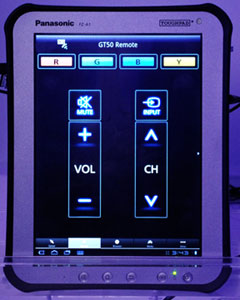
Problem with tablets -- and this includes all of the Android tablets, the iPad, and the Kindle Fire -- is they suck outdoors and they are relatively fragile. Tablets are attempting to do things like replace books and magazines, which you read in bathtubs, on the beach, or outside on a lawn, and they suck in all of those places.
An accidental drop or a little sand or water will turn them into a doorstop, and their displays wash out outdoors. If you want to use one to doodle or draw, their screens are generally not accurate enough -- and even if they were, they typically don't come with anything to draw with.
The Panasonic ToughPad (there's even a 7-inch mini version coming), while much more expensive than an iPad, addresses all of these problems.
It is semi-hardened so it will survive drops or getting wet, and it will shrug off sand. It has a high nit (very bright) non-glare display for outdoor use, so it will work well everyplace except in the brightest of direct sunlight -- and even there you can still see the screen -- and it comes with a built in stylus you can use for drawing.
Besides the display, it has some other decent features that the iPad lacks. It has built-in 4G with a hotspot router that lets you connect your friend's iPad to the Internet, a MicroSD slot for memory expansion, and a micro HDMI to connect to a display or TV. And, of course, it is military specification certified.
Until a product ships in the U.S. with a transflective display -- like the Qualcomm Mirasol (apparently now shipping in Asia) -- and is hardened to boot, the Panasonic ToughPad is my own gold standard for a tablet. I like being outside, and that makes the Panasonic ToughPad my product of the week. This is the product the guys in The Expendables (fun movie by the way) would likely carry.
Thursday, August 30, 2012
Sony Takes Another Swing at Android Tablets With Xperia S

The 9.4-inch Xperia Tablet S is Sony’s latest shot at an Android slate. “Every Android tablet has to be compared against the Nexus 7,” said ABI’s Jeff Orr. Like the Nexus 7, the Xperia Tablet S is based on the Nvidia Tegra 3 processor. However, the Google tablet is priced at $200, while the Xperia Tablet S will be offered in three models starting at $400.
Sony on Wednesday launched the Xperia Tablet S at the IFA consumer electronics show in Germany.

It’s the second generation of the Tablet S, and it continues its predecessor’s positioning as both a tablet and a universal remote control.
However, the Xperia Tablet S is slimmer than its predecessor. Further, it has a quad-core Tegra 3 processor and is now included in Sony’s Xperia sub-brand, which covers mobile experiences and includes the PlayStation.
The Xperia Tablet S will replace the Sony Tablet S, Sony Electronics spokesperson Maya Wasserman told TechNewsWorld. It will be available in the United States on Sept. 7.
Specs for the Xperia Tablet S
The Xperia Tablet S runs Android 4.0. It will be upgraded to Android Jelly Bean when the version becomes available.
The device’s 9.4-inch screen is coated to reduce fingerprint smudges and glare.
The Xperia Tablet S has a full-sized SD card slot and HDMIconnectivity. It also has built-in WiFi capabilities.
Sony will preload redemption codes that will let purchasers access three out of 15 available movies from the Google Play movie library.
Sony Cosa Nostra
The Xperia Tablet S will come with Sony Entertainment Network Services preloaded. This will give users access to music, videos and games from the network. It will also let users store photos and videos in the cloud and share them on any device at any time with friends through Sony’s PlayMemories Online service.
A preloaded Reader app will let Xperia Tablet S owners purchase eBooks from Sony and manage their books across Sony Readers and Xperia smartphones. This fall, Xperia Tablet S owners will be able to access dedicated content from PlayStation Mobile.
Sony also offers Small Apps, which will let Xperia Tablet S owners use minimized versions of various apps simultaneously with another app. Any widgets downloaded to the tablet can be added to the Small Apps.
The tablet’s Socialife feature aggregates owners’ social networking sites and news feeds. Further, Sony offers three media apps on the tablet: Walkman, Album and Movies.
“Sony has a history of doing things differently from other brands,” said Jeff Orr, senior practice director mobile devices at ABI Research. “They work with the standards organization and give a little spin on the end to work with their own ecosystem.”
Making the Android Pilgrimage
Sony hasn’t had much success with its Android tablets so far, but this might change. “It has the user experience and the content ecosystem and now just needs to get its sales and marketing fully functioning,” Peter King, director of tablet and touchscreen strategies atStrategy Analytics, told TechNewsWorld.
However, a lot will depend on whether consumers will appreciate Sony’s quirky approach.
“Every Android tablet has to be compared against the Nexus 7,” ABI’s Orr told TechNewsWorld.
Like the Nexus 7, the Xperia Tablet S is based on the Nvidia Tegra 3 processor. However, the Nexus 7 already runs Android Jelly Bean, the latest iteration of the OS. Further, the Google tablet is priced at US$200, while the Xperia Tablet S will be offered in three models starting at $400.
Controlling the Home Media Center
In the U.S., Sony is marketing the Xperia Tablet S primarily as a remote control device, using infrared (IR) technology.
Pairing IR with DLNA technology “would give users the ability to discover audio and video content on DLNA-enabled devices,” ABI’s Orr pointed out. However, IR is competing with Bluetooth as the standard for remote control devices.
Further, “[we must ask] how does the Sony experience compare with what Apple’s doing with Apple TV and Airplay, and with what Samsung’s offering?” Orr continued. Features in Samsung’s Smart TV line include facial recognition, gesture recognition and a variety of apps.
Also, users with iPhones who want to fit it into the Sony [home entertainment] environment need to figure out if that will work, Orr said. “It probably doesn’t.”
Wednesday, August 29, 2012
Apple's Record-Breaking Value: Hard to Reach, Hard to Keep
ueled by a mountain of cash combined with excitement over upcoming products, Apple's value has reached new heights, making it the most valuable publicly traded company in history. How long it can stay at that peak, however, is anyone's guess. "Many companies whose total value was huge only 20 years ago, such as Microsoft, IBM and GE, have a total value smaller today," said Siegel+Gale's Russ Meyer.
The stock market can't get enough of Apple, it would seem. On Monday the company's shares passed the US$664 mark, setting a new record as the most valuable publicly traded company in history. On Tuesday morning the legend continued: Apple's stock rose close to 1 percent, trading at $671.30 per share before hitting a mid-morning decline.
Apple is the tech industry's darling, its golden child. It would be easy to attribute Monday's events to merely its overall aura of financial invincibility.
Recent events that might have given Apple's stock an extra push, however, include the growing anticipation of its next iPhone, expected to arrive this fall, as well as a rumored iPad mini and a possible full-sized television.
What's at Work Here?
Then there's the matter of Apple's huge cash stockpile, Russ Meyer, global strategy
 director for branding firm Siegel+Gale, told MacNewsWorld.
Essentially, he said, "what people will pay for the product is relatively high, and Apple's costs are relatively low. Thus, a lot of cash being created."
More immediately, though, the rumored upcoming product launches have been driving Apple's stock price, he said. "Given Apple's track record of creating -- and recreating -- products that exceed customer needs, are different than the competition and create a simple, delightful experience, investors are anticipating Apple will do it again with these new product launches." Thus, he said, the price of the stock rises with the expectation of even more brand-driven cash being created.
How Long Can It Last?
It's unclear whether Apple can maintain such heights, especially if one accepts that the rumored products in its pipeline are indeed the driver behind the recent increases.
"The iPhone 5 and 7-inch tablets will face a lot more competition this time, and the iPhone 5, based on what has leaked out of Apple, had far less of Steve Jobs in it than expected," Rob Enderle, principal analyst with the Enderle Group, told MacNewsWorld. "I'm hearing it was basically built by committee, which suggests it may not meet expectations."
That means, he continued, that there is a lot of risk to investors who think Apple will maintain this valuation. Also, he added, he has his doubts about the "most valuable company in history" title. "If you adjust for inflation, you'll likely find firms like the original Standard Oil, before the market collapse, and even Microsoft were more highly valued at their peak."
Apple, though, "is clearly the most valuable company in recent memory," he conceded.
"It's hard to stay on top forever," Meyer added. "Many companies whose total value was huge only 20 years ago, such as Microsoft, IBM and GE, have a total value smaller today.
But, he added, while it may be true that inevitably Apple will be overtaken by some other company, it is harder to make a case that Cupertino's surge is fueled entirely by hype and hot air.
Apple's P/E ratio is actually relatively low (15.57) compared to the overall S&P 500 (16.1), Meyer said, as well as to other tech stocks like Facebook (68.51) or Amazon (291.73).
"Stocks in the midst of a bubble usually have a relatively high P/E ratio. This doesn't seem to be the case with Apple," he explained.
Best Ever Title Not Necessarily a Prize
Still, Apple may regret the day it was crowned "most valuable."
"The biggest problem with being the best ever is that you also have to maintain 'perfection,' which everyone knows is impossible, even if you are considered the 'best ever,'" Jeff Sica, president and chief investment officer of SICA Wealth Management, told MacNewsWorld.
"The greatest problem with Apple is that despite its monumental technological innovation of the past, it's what's next that counts. The innovative mind behind Apple, Steve Jobs, has passed, and since his departing, there has been limited innovation at Apple."
It will be only after Apple proves it can continue to innovate, instead of just rolling out new versions of established products, that they can justify their "best ever" designation, he said.
Curiosity Rover Zeroes In on Traces of Past Habitats on Mars
At 10:31 P.M. Pacific time on August 5, NASA’s Curiosity rover will begin the first direct search for habitable environments on Mars
All science begins in a star trek mode: go where no one has gone before and discover new things without knowing in advance what they might be. As researchers complete their initial surveys and accumulate a long list of questions, they shift to a Sherlock Holmes mode: formulate specific hypotheses and develop ways to test them. The exploration of Mars is now about to make this transition. Orbiters have made global maps of geographic features and composition, and landers have pieced together the broad outlines of the planet’s geologic history. It is time to get more sophisticated.
Our team has built the Mars Science Laboratory, also known as the Curiosity rover, on the hypothesis that Mars was once a habitable planet. The rover carries an analytic laboratory to test that hypothesis and find out what happened to the early clement environment we believe the planet had. Loosely defined, a habitable environment has water, energy and carbon. Past missions have focused on the first requirement and confirmed that Mars had—and occasionally still has—liquid water [see “The Red Planet's Watery Past,” by Jim Bell; Scientific American, December 2006]. Those missions have also seen hints of geochemical gradients that would provide energy for metabolism. But none has seen carbon in a form potentially suitable for life.
Tuesday, August 28, 2012
Gospel music in Paris flourishes
France may be the most militantly secular country in Europe, but Paris’s gospel scene is flourishing.
The choir sways and their orange robes sway with them. The conductor, packed in an ice-cream-white suit, urging them on, while out front the Reverend Jean Carpenter – moving quite possibly like nobody has ever moved before in this ancient church in the medieval heart of Paris – sings praise to the Lord.
The person who emailed to say I should go and hear her sing described her voice in one word – “Biiiiiiiiiiig”.
She wasn’t exaggerating.
“Oh my gosh!” she cries when asked how she feels when she’s up there performing. “I want to dance! I want to sing! I want to touch everybody! I want to touch Jesus! I want to see his face! When I’m up there, I feel love.”
Not the sort of thing the French are used to hearing.
France – with its burka ban, and strict separation of church and state – is the most militantly secular country in Europe. Many people regard religion with suspicion and even the six per cent who regularly go to church are often shy of using the J-word, let alone shaking their stuff in church to praise Him.
It’s a difference in religious culture as wide as the Atlantic, which is maybe one reason gospel concerts here sometimes provoke intense reactions.
“I don’t preach, but I speak ‘Franglais’ with the people and they help me with my French,” says Jean, who hails from Queens in New York State. “I ask them if they understand and they say ‘Yes!’ And sometimes we all end up in tears. We end up touched by what comes through me and then, in essence, it touches them and then they give it back. We can have such a powerful time.”
Like the time a man who’d lost his daughter came to talk to her after the concert.
“She had died. He told me he needed prayer,” Jean recalls. “And needed someone to pray with. So we held him, we hugged him and cried with him and we found the priest of a church and we put him in contact with that church.
“That is what we are hoping to do. Not just do a show and leave. No! No! I would not have done my job if that happens.”
For Jean Carpenter and the other singers on Paris’s flourishing gospel scene, this music is not a style – it is a mission.
Indeed, she says, the reason she moved here was that, after singing in Paris for the first time on tour in 2004, she thought her voice and her ministry would make more impact in France than back in the USA.
“African-American gospel? Oh, the French just go crazy,” says another long-term Paris resident Ricki Stevenson. She is the creator of Black Paris Tours, which guides tourists round the landmarks of black America’s long love affair with this city.
“It’s kind of surprising, but the French just have a passion for this music,” she says. “They feel deeply those sounds. It touches them in a way that I have not seen a lot of others being touched.”
Gospel musicians were at the forefront of a movement of black American artists from the US to France. Later on came the likes of Sidney Bechet, Josephine Baker and Louis Armstrong. But the first were a gospel ensemble called The Fisk Jubilee Singers, who came to Paris as early as the 1870s.
They also performed in England during that tour and sang “Go Down, Moses” to Queen Victoria.
The Wilberforce Choir came to Paris in the 1900s. Much later, in the 1950s, one of the most celebrated gospel groups of all time, the Golden Gate Quartet, didn’t just play in Paris, it settled down in the city and stayed.
Still swinging at 84, lead singer Clyde Wright remains in Paris today.
Sure, he says, there was racism in France too. You could still see the same dark looks in some people’s eyes. But there wasn’t the institutionalised racism he’d known growing up in North Carolina.
“We had to walk about three kilometres (two miles) to get to school,” Wright remembers.
In the winter time, it was cold with no shoes on your feet or whatever shoes you could find. There was a bus, but on that bus there were about 13 whites – boys and girls on their way to their brick school. And that bus would just pass by us, and if you were in the way, he would blow the horn and say, ‘Get over’… not one would stop and say, ‘Get in’. That was out of the question.”
Gospel music was the milk he was raised on.
“I’m very religious,” he says. “I’ve sung other songs, but for me it has no meaning. It’s just for the pleasure of people. But (gospel) is soul music and that is something that I learned as a child. In pop music, they have what they call soul music, but soul music, in reality, it’s the old negro spirituals sung in the days of slavery.”
At a Paris club called the Speakeasy, a few paces from the Arc de Triomphe, another pillar of the Paris gospel scene, Linda Lee Hopkins, even throws in the occasional gospel number when she’s singing to the night-time cocktail crowd.
She’s full of stories about how the Holy Spirit works through this music – about French people in tears, French people feeling something, French people getting over their initial hostility to anyone or anything to do with religion. But sometimes, when they’re booking her in to play somewhere, people ask her to tone down the God stuff.
“They want you to compromise sometimes. They want gospel because they think it’s radio music – especially the songs from Sister Act,” she says. “I tell them, ‘That is not gospel. They are secular songs adapted for the film.’ So if they tell me, ‘I want you to sing gospel, but don’t mention Jesus.’ It’s like He’s my life, I cannot not mention Him!”
They don’t always understand, says Linda Lee Hopkins.
Wanting gospel music without the gospels, without Jesus, without the Lord, is like wanting cake without the flour, she says. So what does she do? She leaves it up to the Holy Spirit. If He wants her to sing about Jesus, she does. And guess what? He does.
Why Does Music Make Us Feel?
A new study demonstrates the power of music to alter our emotional perceptions of other people
As a young man I enjoyed listening to a particular series of French instructional programs. I didn’t understand a word, but was nevertheless enthralled. Was it because the sounds of human speech are thrilling? Not really. Speech sounds alone, stripped of their meaning, don’t inspire. We don’t wake up to alarm clocks blaring German speech. We don’t drive to work listening to native spoken Eskimo, and then switch it to the Bushmen Click station during the commercials. Speech sounds don’t give us the chills, and they don’t make us cry – not even French.
But music does emanate from our alarm clocks in the morning, and fill our cars, and give us chills, and make us cry. According to a recent paper by Nidhya Logeswaran and Joydeep Bhattacharya from the University of London, music even affects how we see visual images. In the experiment, 30 subjects were presented with a series of happy or sad musical excerpts. After listening to the snippets, the subjects were shown a photograph of a face. Some people were shown a happy face – the person was smiling – while others were exposed to a sad or neutral facial expression. The participants were then asked to rate the emotional content of the face on a 7-point scale, where 1 mean extremely sad and 7 extremely happy.
The researchers found that music powerfully influenced the emotional ratings of the faces. Happy music made happy faces seem even happier while sad music exaggerated the melancholy of a frown. A similar effect was also observed with neutral faces. The simple moral is that the emotions of music are “cross-modal,” and can easily spread from sensory system to another. Now I never sit down to my wife’s meals without first putting on a jolly Sousa march.
Although it probably seems obvious that music can evoke emotions, it is to this day not clear why. Why doesn’t music feel like listening to speech sounds, or animal calls, or garbage disposals? Why is music nice to listen to? Why does music get blessed with a multi-billion dollar industry, whereas there is no market for “easy listening” speech sounds?
In an effort to answer, let’s first ask why I was listening to French instructional programs in the first place. The truth is, I wasn’t just listening. I was watching them on public television. What kept my attention was not the meaningless-to-me speech sounds (I was a slow learner), but the young French actress. Her hair, her smile, her mannerisms, her pout… I digress. The show was a pleasure to watch because of thehumans it showed, especially the exhibited expressions and behaviors.
The lion share of emotionally evocative stimuli in the lives of our ancestors would have been from the faces and bodies of other people, and if one finds human artifacts that are highly evocative, it is a good hunch that it looks or sounds human in some way.
As evidence that humans are the principal source of emotionality among human artifacts, consider human visual signs. Visual signs, I have argued, have culturally evolved to look like natural objects, and have the kinds of contour combinations found in a three-dimensional world of opaque objects. Three-dimensional world of opaque objects? Nothing particularly human about that, and that’s why most linguistic signs – like the letters and words on this page – are not emotionally evocative to look at.
But visual signs do sometimes have emotional associations. For example, colors are notoriously emotionally evocative, and arguments about what color something should be painted are the source of an alarming number of marital arguments. And “V” stimuli, such as that yield sign on the street, have long been realized (within the human factors literature) to serve as the most evocative geometrical shape for warning symbols. But notice that color and “V” stimuli are plausibly about human expression. In particular, color has recently been argued to be “about” human skin and the exhibited emotions – which is why red grabs our attention, since it’s associated with blushing and blood – and “V” stimuli have been suggested to be “about” angry faces (namely, angry eyebrows).
Which brings us back to music and the Logeswaran paper. Music is exquisitely emotionally evocative, which is why a touch of happy music makes even unrelated pictures seem more pleasant. In light of the above, then, we are led to the conclusion that the artifact of music should contain some distinctly human elements.
The question, of course, is what those elements are. One candidate is our expressive speech – perhaps music is just an abstract form of language. However, most of the emotion of language is in the meaning, which is why foreign languages that we don’t understand rarely make us swoon with pleasure or get angry. That’s also why emotional speech from an unfamiliar language isn’t featured on the radio!
But there is a second auditory expressive behavior we humans carry out – our bodily movements themselves. Human movement has been conjectured to underlie music as far back as the Greeks. As a hypothesis this has the advantage that we have auditory systems capable of making sense of the sounds of people moving in our midst – an angry stomper approaching, a delicate lilter passing, and so on. Some of these movements trigger positive emotions – they conjure up images of pleasant activities – while others might be automatically associated with fear or anxiety. (The sound of running makes us wonder what we’re running from.) If music were speech-driven, then it is missing out on the largest part of speech’s expressiveness – the meaning. But if music sounds like human expressive movements, then it sounds like something that, all by itself, is rich in emotional expressiveness, and can be easily interpreted by the auditory system.
Regardless of whether music is emotional intonation from speech or a summary of expressive movements – or something else altogether – the new research by Logeswaran and Bhattacharya adds yet more fuel to the expectation that music has been culturally selected to sound like an emotionally expressive human. While it is not easy for us to see the human ingredients in the modulations of pitch, intensity, tempo and rhythm that make music, perhaps it is obvious to our auditory homunculus.
Monday, August 27, 2012
A brief history of Gospel music Part II
1960s to present day
The financial success of secular black music in the 1960s and 70s ushered in a new kind of Gospel artist: more performance-aware yet equally spiritually and socially engaged. They included the ‘Godfather of Soul’ James Brown, Aretha Franklin, Reverend Al Green, Sam Cooke, Shirley Cesaer and The Staple Singers. It was common for these artists to chose one side of Gospel’s divide as religious and secular music industry did not mix. It also confirmed the acceptance of Gospel artists as solo performers.
In the 70s and 80s artists like the Mighty Clouds of Joy, Andrae Crouch, Commissioned and Candi Staton brought the popular sounds of disco, funk and other mainstream genres into the growing spectrum of Gospel. This era also brought to prominence some of Gospel’s biggest musical families including The Clark Sisters, The Hawkins and The Winans.
The 90s brought an R’n'B crossover explosion when Gospel artists such as Sounds of Blackness, Helen Baylor and Bebe and Cece Winans scored big international chart and club hits. This was also a good time to be ‘Gospel’ and British, as record companies took note of the US success and tried to emulate it with homegrown artists like Paul Johnson, The Escofferys, Nu Colours, Mica Paris, Ruby Turner, Patrick Jean-Paul Denis, Lavine Hudson and Bryan Powell. This favourable mood also bolstered recognition for the existing traditional Gospel groups like the London Community Gospel Choir and the Inspirational Choir.
The current genres of Gospel owe as much to its rich heritage as they do to the upbeat performance of urban or ‘street music’. Kirk Franklin, Tye Tribbett, Tonex and J Moss have adopted a Holy Hip Hop attitude in bringing the ‘good news’ to a younger generation. However, the popularity of more traditional artists like Smokie Norful, Donnie McClurkin and Yolanda Adams remains strong.
Today’s UK Gospel sound celebrates the full spectrum of Gospel music, with funk bands like Four Kornerz, praise and worship with the traditional ‘church’ sound of Noel Robinson and Nu Image and the African influence of Muyiwa and Riversongz, and the urban styling of groups like Raymond and Co and Siani, and solo performers like Priscilla Jones and Roger Samuels. It also includes other subgenres like house, reggae and grime that dominate youth culture.
Subscribe to:
Posts (Atom)